![Bioluminescent Glowing Forest Trail [Goa & Dodamarg]](https://konkantravelclub.com/wp-content/uploads/2025/05/Glowing-Mushroom-goa.png "Herping: Learning to Read the Forest Beyond Fear 2")
May 7, 2025/
No Comments
Step into the heart of Goa’s forests after dark and discover a world that glows. The Bioluminescent Forest Trail is...

We Plan, You Pack!
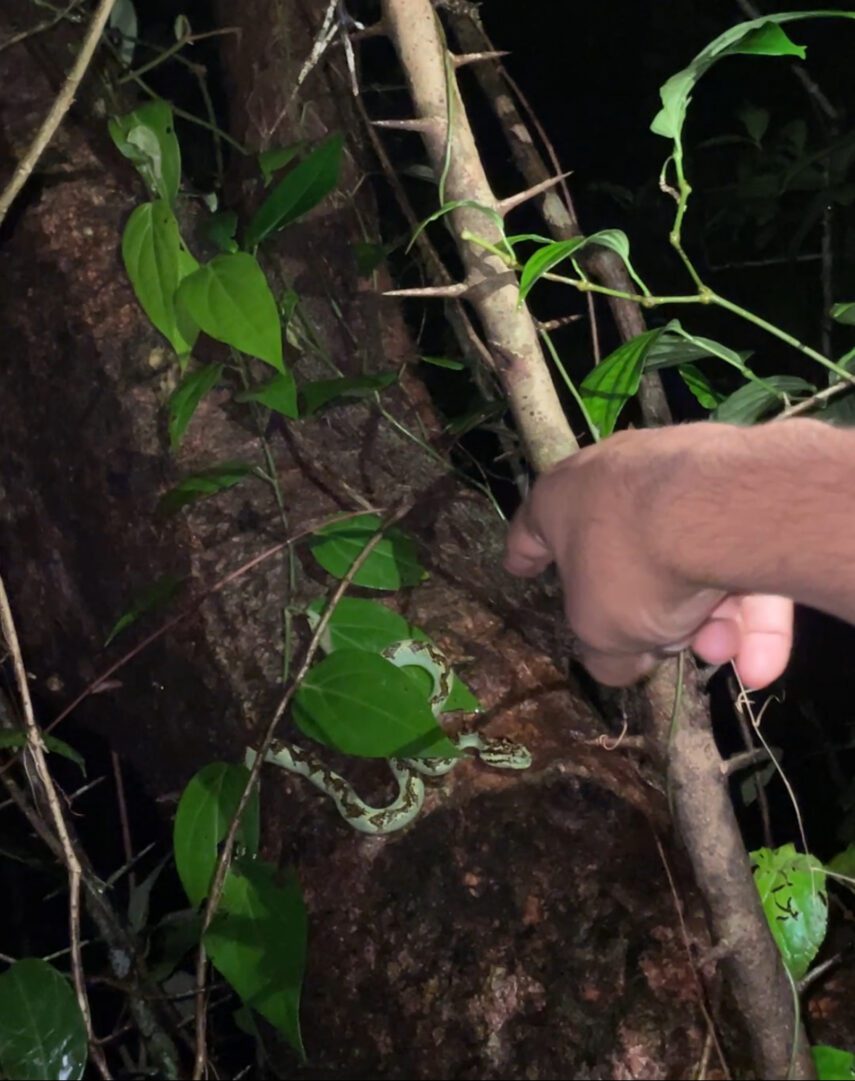
Walk through any forest after sunset and you’ll notice a change in the way people behave. Conversations become quieter. Every movement in the leaf litter draws attention. A branch brushing against your leg can be enough to make you jump. For many of us, forests become intimidating after dark, not because they are inherently dangerous, but because we don’t understand what is around us.
Most people grow up hearing stories about snakes, poisonous lizards, or mysterious creatures that emerge at night. These stories stay with us far longer than facts. As adults, we often carry these assumptions into the wild, even if we’ve spent very little time observing wildlife ourselves.
Herping offers a different way to experience nature.
The word herping comes from herpetofauna—the collective term for reptiles and amphibians. Simply put, herping is the practice of observing reptiles and amphibians in their natural habitats. It isn’t about catching animals, disturbing them or ticking species off a list. Good herping is slow, patient and respectful. It is about understanding wildlife where it belongs.
For many people, the first herping walk is a surprise. They expect to spend the evening looking for snakes. Instead, they discover that finding reptiles and amphibians depends on understanding the forest itself.
A frog doesn’t appear randomly beside a puddle. A vine snake isn’t sitting on just any branch. A gecko isn’t outside your window by accident. Every animal occupies a habitat that provides food, shelter, suitable temperatures and protection from predators.
Once you begin noticing these patterns, the forest starts to make sense.
Rather than asking, “Where can I find a snake?”, you begin asking, “What kind of habitat would support one?”
That shift in thinking is what makes herping so rewarding.
Experienced naturalists often seem to find wildlife effortlessly. Visitors sometimes assume they have exceptional eyesight or simply know where to look.
In reality, they are reading clues.
A shaded stream may indicate frogs and freshwater snakes. Fallen logs provide shelter for skinks and geckos. Leaf litter supports insects, which in turn attract frogs, lizards and other predators. A warm rocky outcrop may become a basking site for reptiles during the morning.
Every habitat tells a story.
As you spend more time observing these relationships, you realise that wildlife isn’t scattered randomly across the landscape. Every species has evolved to occupy a particular niche, and every habitat offers clues about the animals that may live there.
This way of observing extends beyond reptiles and amphibians. Once you begin paying attention to habitats, you’ll start noticing birds, insects, spiders, fungi and plants that you previously walked past without a second glance.
Herping, in many ways, is not about learning to find snakes.
It is about learning to notice life.
Fear has an important purpose. It encourages caution when we encounter something unfamiliar. The problem arises when fear is shaped more by myths than by knowledge.
Reptiles and amphibians are among the most misunderstood animals in the natural world.
Many people believe that every snake is venomous, that snakes chase people, that frogs cause warts, or that lizards are poisonous. These misconceptions have been passed down through generations, despite having little scientific basis.
Understanding how these animals actually behave changes the way we respond to them.
Most reptiles would rather avoid people altogether. A snake encountered on a trail is usually trying to remain unnoticed or looking for an escape route. Frogs are far more concerned with finding mates and avoiding predators than interacting with humans. Geckos quietly spend their nights feeding on insects around lights, providing a natural form of pest control.
The more you understand their behaviour, the easier it becomes to predict it.
That doesn’t mean becoming careless. Wildlife should always be treated with respect and given adequate space. But understanding replaces unnecessary panic with informed caution.
One of the greatest benefits of herping is that it equips people with practical knowledge for spending time outdoors.
Whether you’re trekking, camping, photographing wildlife or simply exploring nature, understanding animal behaviour makes every experience safer.
During a guided herping walk, participants learn to move slowly and observe carefully rather than rushing through a trail. They learn where animals are likely to rest and why stepping over logs or placing hands into rock crevices without looking first is never a good idea.
Simple habits make a significant difference:
Stay on established trails whenever possible.
Watch where you place your hands and feet.
Never attempt to handle or provoke wildlife.
Use a torch while walking after dark.
Give every wild animal enough space to move away.
Observe quietly instead of trying to force an encounter.
Ironically, these practices make wildlife encounters more enjoyable as well. Animals are far more likely to continue behaving naturally when they don’t perceive people as a threat.
Herping isn’t about getting as close as possible.
It’s about observing without interfering.
Few animals inspire as much fear as snakes.
India is home to more than 300 species of snakes, yet only a small proportion possess venom capable of causing serious medical emergencies in humans. Even among venomous species, bites generally occur when snakes are accidentally stepped on, cornered, handled or deliberately disturbed.
Snakes do not hunt humans.
They do not waste valuable venom attacking animals they cannot eat.
Their primary goal during an encounter is usually the same as yours—to avoid conflict.
Each species occupies its own ecological role.
Rat snakes help control rodents around farms and villages.
Keelbacks are commonly associated with streams where they feed on frogs and fish.
Vine snakes spend much of their lives almost invisible among shrubs and low branches, relying on camouflage instead of speed.
Pit vipers often remain perfectly still, trusting their camouflage to keep them hidden.
Learning these behaviours changes how you interpret encounters.
Instead of reacting with panic, you begin asking practical questions.
Why is the snake here?
What habitat does it depend on?
Is it trying to escape?
What behaviour is it displaying?
These questions encourage observation rather than fear.
Perhaps most importantly, herping teaches respect rather than confidence. The objective is never to identify snakes closely enough to handle them. It is to appreciate them from a safe distance while understanding the important role they play in maintaining healthy ecosystems.
If snakes dominate conversations about wildlife, frogs dominate the soundscape of the monsoon.
After the first heavy rains, forests that seemed quiet only days earlier come alive with calls from dozens of species, each with its own purpose. These calls are primarily breeding advertisements. Male frogs call to attract females and establish territories.
Many people are surprised to discover that different habitats support different frog communities.
Some species breed in streams.
Others depend on temporary rain-fed puddles.
Some lay eggs on leaves above water.
Others spend most of the year hidden underground, emerging only for a brief breeding season.
Frogs are also among the most important indicators of environmental health. Because they absorb water through their skin, they are highly sensitive to pollution and changes in habitat. Healthy frog populations usually indicate healthy freshwater ecosystems.
Once you begin recognising frog calls and understanding their behaviour, the monsoon sounds less like background noise and more like a conversation taking place all around you.
Finding wildlife is exciting.
Finding wildlife without disturbing it is far more rewarding.
Ethical herping places the welfare of animals above photographs or sightings.
Animals should never be chased, restrained or handled simply for a better view. Rocks, logs and bark that are moved while searching should always be returned to their original position, as these microhabitats provide shelter for many species. Flash photography should be used responsibly, and sensitive breeding sites should never be damaged for access.
A good herper leaves the forest exactly as they found it.
The best compliment a naturalist can receive is that the wildlife continued behaving naturally in their presence.
People often assume the highlight of a herping walk is seeing a snake.
Sometimes it is.
But more often, the lasting takeaway is something less tangible.
You’ll understand why animals occur where they do.
You’ll recognise habitats instead of seeing an undifferentiated forest.
You’ll learn to distinguish genuine risks from imagined ones.
You’ll know how to respond calmly and responsibly during wildlife encounters.
You’ll appreciate reptiles and amphibians not as creatures to fear, but as essential parts of a functioning ecosystem.
Long after the walk is over, every future trek becomes different.
You’ll notice the stream that could support frogs after rain.
You’ll recognise why a fallen log shouldn’t be disturbed.
You’ll understand why a gecko waits beneath a light or why a snake chooses the edge of a forest trail.
In short, you’ll stop walking through the forest and begin observing how it works.
That is what herping truly teaches.
It isn’t just about reptiles and amphibians.
It’s about learning to read the forest.
Step into the heart of Goa’s forests after dark and discover a world that glows. The Bioluminescent Forest Trail is...

Explore the hidden nocturnal wildlife of the Western Ghats on a guided Herping Night Trail in Amboli and Surla. Search...
“The first step in solving a problem is recognizing there is one” ~ Will McAvoy
Talk to us..